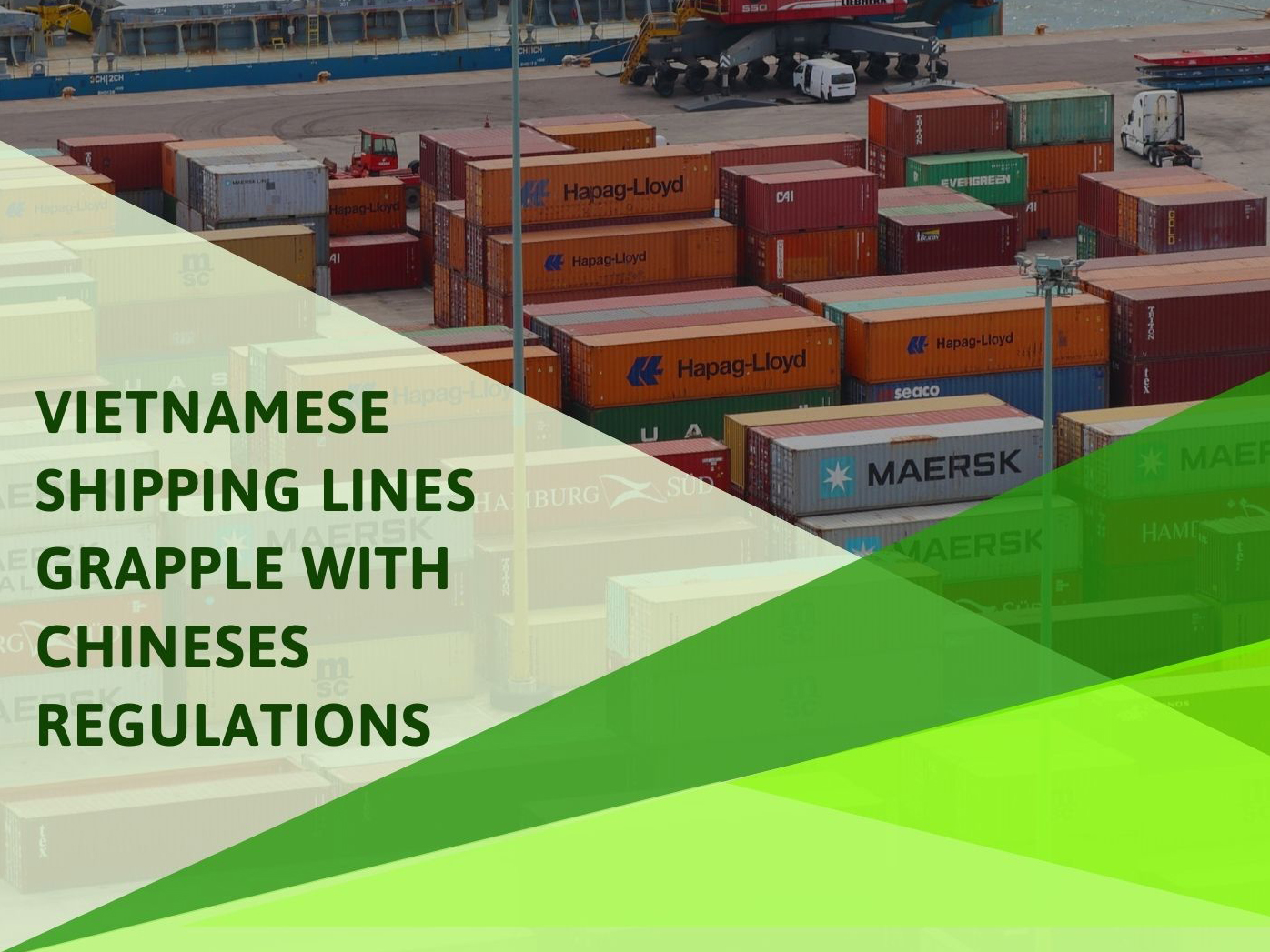
Vietnamese shipping lines grapple with Chineses regulations
Vietnamese shippers are attempting to continues trade at Chinese port despite the upphil struggle in unloading and keeping crew members and ships safe.
Dang Hong Truong deputy general director of Vietnamese ocean shipper VOSCO, is still feeling a headache with cargo ships stranded in container ports in China. Normally, it takes about five days for clearance of 50,000DWT vessels at Chinese ports, but restrictions now mean itrs often takes much longer.
When any shipping line arrive at Chinese ports, all crew have their temperatures checked. If a crew is infected with COVID 19, a line wiil have to wait 14-21 days in anchorage. At some ports, crew can get a rapid test or carry out a PCR test before getting anchored. Shipping lines have to return home iff an infection is found, and then a blockade is applied at a berth.
“The number of vessel does not increase, while the prolonged stranded period will result a lack of vessel amid rising trade volume, thus is increasing freight cost, leasing fees and commodity prices,” Truong explained. Many Vietnamese shipping firms shifted to leasing vessel instead of operating them on the Chinese routes.”
Similarly, Saigon Newport Corporation is also struggling. Deputy general director Nguyen Dai Hai said that port operators normally pay for COVID-19 testing and disdinfectant spraying. However, in some Chinese areas, vessel operator have to cover the payment. China does not currently accept vaccine passports or testing results from Vietnam.
The strict rules have increased frieght cost and additional fee, and even a loss os dozens os thousands of US dollars due to returns if an infection emerges. A 50,000 DWT vessel has a leasing fee of $20,000 a day, and is the trip is delayed 10 days due to on infection, a shipping firm may lose about $200,000, depending on the type of contract.
In addition to extra cost, shipping firms have to bear contract fines due to the slowly delivery of commodities and a reduction in operational frequency
Despite being g aware of the risks and losses, shipping firms keep running on the Chinese routes because it is the biggest export-import market in the world. Bilateral trade between Vietnam and China still recorded strong growth in 2021, despite the harsh disruption. China continues to be Vietnam's largest trading partner and second-largest export market, while Vietnam was China's largest trading partner in ASEAN and its sixth-largest trading partner globally.
Instead, shippers look to mitigate negative impacts by keeping crews unchanged on the Chinese routes.
"The risk is that some people can test positive for COVID-19 after several days on board, although they earlier tested negative. This remains a big headache," Hai lamented. "We always have masks and use disinfection test kits as well as temperature and anti-virus drugs on board."
Minh Tien from Bien Dong Shipping Co., Ltd. added that the same crew could be on board for 8-12 months. Tien's company limits contact with crews on the Chinese routes. "These staff on board for such a long time may be psychologically affected, thus affecting the entire safety of the ship. In case of force majeure, which would force shipping lines to change their crew, they have to cover COVID-19 testing fees," he said.
Tien proposed that authorised agencies work out policies on supporting businesses in procedures for crews if they are on board for too long. As ruled in 2006's Maritime Labour Convention, the maximum period of working on board is 12 months.
China's continuing strict pandemic policy has left hundreds of cargo ships stranded in ports, and not only Vietnamese ones. Maersk, the world's second-largest shipping company, has suggested that the lockdowns are severely impacting truck services, and transport costs would witness a rise at an unexpected level. It is said that 90 per cent of the world's goods are carried via the sea.
Due to strict rules, many ports in China have been heavily congested, such as Yantian in Guangdong province. It was blockaded in early March and, when restrictions were removed from March 20, data from maritime intelligence company Windward showed a soar of over 50 per cent in the number of port calls. In April, the average transportation time from a port to Yantian among vessels rose 98 per cent on-year, and it took container vessels from Vietnam an extra 45 per cent of time in the sea before being able to call at a Chinese port.
Many Vietnamese shipping firms said that in the past, they could carry out unloading when making a call at ports in Hong Kong or Shanghai, but now it takes at least three days for port calls.
China is home to half of the world's 20 largest container ports by yearly throughput, and experts say that if the delays continue for an unexpected period, other ports may not be capable of filling the void, with some factories finding it challenging to keep momentum going due to the high curbs felt over the past year and more.
Source: Aloha International Logistics Company